.png)
Is Your Bezel Turning Yellow?

Don't Blame the Watchmaker. In many cases, it's not the bezel itself that is changing. The real damage often happens insidethe luminous material embedded in the bezel insert. Not every sign of ageing is a flaw. Sometimes, it's simply proof of a life well lived.
The first real days of summer always feel the same.
The car is packed a little too full. Sunglasses disappear somewhere between the luggage. The first espresso tastes different once you've crossed the Alps, and before long the Mediterranean appears on the horizon. Your watch catches the sunlight as you reach for the steering wheel, reminding you why mechanical watches belong on adventures rather than in safes.
Weeks later you return home with a slightly darker tan, a phone full of photographs, and a watch carrying a few more stories than when you left.
Perhaps there's a small scratch on the clasp. A tiny mark on the crystal that only you know exists. Or maybe you've noticed something unexpected: your once brilliantly white bezel has developed a soft cream tone.
The immediate reaction is understandable.
"Has something gone wrong?"
Fortunately, the answer is usually no.
Just like leather develops character and denim fades beautifully, white bezel inserts can slowly change over time. It's rarely a manufacturing defect. More often, it's the result of countless hours spent in bright sunlight, long afternoons by the pool, generous applications of sunscreen, and perhaps a little too much hand sanitizer left over from recent years.
In other words, your watch may simply be wearing the memories of another unforgettable summer.
Why Is Your Bezel Turning Yellow?
Have you noticed the white luminous markers in your ceramic bezel insert taking on a slightly warmer tone after a few summers? At first glance, it may appear as though the bezel itself is ageing. In reality, the ceramic bezel insert rarely changes colour.
The engraved bezel markers are filled with Swiss Super-LumiNova®, a high-performance luminous compound. This luminous material is secured within the engraved ceramic insert using a transparent resin. While Swiss Super-LumiNova® itself is exceptionally stable, the resin surrounding it can gradually deteriorate after years of exposure to sunlight, salt water, chlorine and certain chemicals such as DEET, some sunscreen ingredients, alcohol-based hand sanitizers and acetone.
As the resin ages, the luminous filling may develop a warmer tone, lose brightness or, in more severe cases, begin to deteriorate. This subtle change is often mistaken for a yellowing bezel, when the ceramic insert itself usually remains unchanged.
Let's be clear: this is not a defect in your watch, nor is it a flaw in Swiss Super-LumiNova®. It is simply the natural ageing of the transparent resin surrounding the luminous material—a characteristic of the material rather than a manufacturing fault. Understanding what accelerates this process is the key to preserving your watch for many years to come.
Ageing is inevitable.
The question isn't if it happens.
It's how it happens


1. Mediterranean Sun: UV Never Takes a Holiday
Few places are more beautiful than the Mediterranean in summer.
Blue skies. Endless sunshine.
Salt in the air.
Long lunches that somehow become dinners.
Your watch enjoys every minute of it.
Unfortunately, ultraviolet light never takes a day off.
UV radiation slowly affects many materials, including certain resins, polymers and protective finishes used throughout countless industries. Over time, bright white surfaces can become slightly warmer in colour.
The change is often so gradual that owners don't notice it until they compare the watch with an old photograph or a brand-new bezel.
Ironically, the very sunshine that creates your favourite holiday memories is also responsible for some of the character your watch develops.
Rather fitting, isn't it?
2. Sunscreen & Mosquito Spray: Summer's Invisible Chemistry
If there's one thing your watch sees almost as often as sunlight, it's sunscreen.
A generous amount on your wrists before heading to the beach.
Another application after lunch.
Perhaps a little mosquito repellent before dinner on the terrace.
Modern sunscreens are remarkable products, but they contain oils, UV filters and chemical ingredients that may interact with certain plastics and coatings after repeated exposure.

Mosquito repellents containing DEET can be even more aggressive. DEET is well known for affecting plastics and synthetic materials, which is why manufacturers often recommend avoiding direct contact with sunglasses, camera equipment and watches.
That doesn't mean your watch is fragile.
It simply means that mechanical watches, like everything else we wear, appreciate a little arrention and care.
A simple rinse with fresh water after a day at the beach removes salt, sunscreen residue and other contaminants before they have the chance to settle.
It's a small habit that every experienced diver already knows.
3. Pool Chlorine: Crystal Clear Water, Less Kind to Materials
There's something irresistible about a pool on a warm summer afternoon.
You dive in, surface a few moments later, glance at your watch and realise you've completely lost track of time. Exactly as a holiday should be.
Your Ligure is built to handle water. Swimming itself isn't the issue.
The water chemistry can be.
Pool water contains chlorine and other disinfectants that keep it sparkling clean, but over the years these chemicals can gradually affect rubber, polymers, gaskets and certain finishes. Combined with heat and strong UV exposure, they may also contribute to subtle colour changes in white materials.
Nothing dramatic happens overnight.
It's the accumulation of hundreds of swims over many summers that slowly leaves its mark.
Fortunately, prevention is simple.
A quick rinse under fresh water after leaving the pool removes chlorine residue in seconds and helps preserve your watch for many seasons to come.

4. The Corona Legacy: Hand Sanitizers
Five years ago, hardly anyone gave hand sanitizer a second thought.
Then the world changed.
For a while, we all carried small bottles everywhere. Airports, restaurants, shops, hotels—cleaning our hands became second nature.
Most sanitizers contain a high percentage of alcohol. While they're excellent at disinfecting hands, repeated exposure isn't ideal for every material found in everyday products, including certain plastics, coatings and rubber components.
Your watch has probably survived thosands of applications without complaint.
"Kills 99.9% of bacteria. Tough on germs. Tougher on bezels"
Still, if sanitizer frequently runs between your wrist and your watch, small cosmetic changes may slowly appear over time.
It's another reminder that watches don't just measure the passing of time.
They quietly witness history as well.
A Few Simple Habits Go a Long Way
The good news?
Looking after your watch requires remarkably little effort.
A few simple habits make all the difference:
Rinse your watch with fresh water after swimming in the sea or a chlorinated pool.
Wipe away sunscreen or insect repellent if it comes into contact with the bezel.
Avoid prolonged exposure to harsh chemicals whenever possible.
Clean your watch regularly with lukewarm water, mild soap and a soft cloth.
Most importantly: wear it often. Mechanical watches are happiest on the wrist, not hidden away in a drawer.
After all, a dive watch wasn't designed to spend its life inside a watch box.
It was designed to accompany yours.
Can The Yellow Lume Be Restored?
Absolutely!
If a bezel insert has discoloured beyond your liking, replacing the insert is usually a straightforward procedure for an experienced watchmaker.
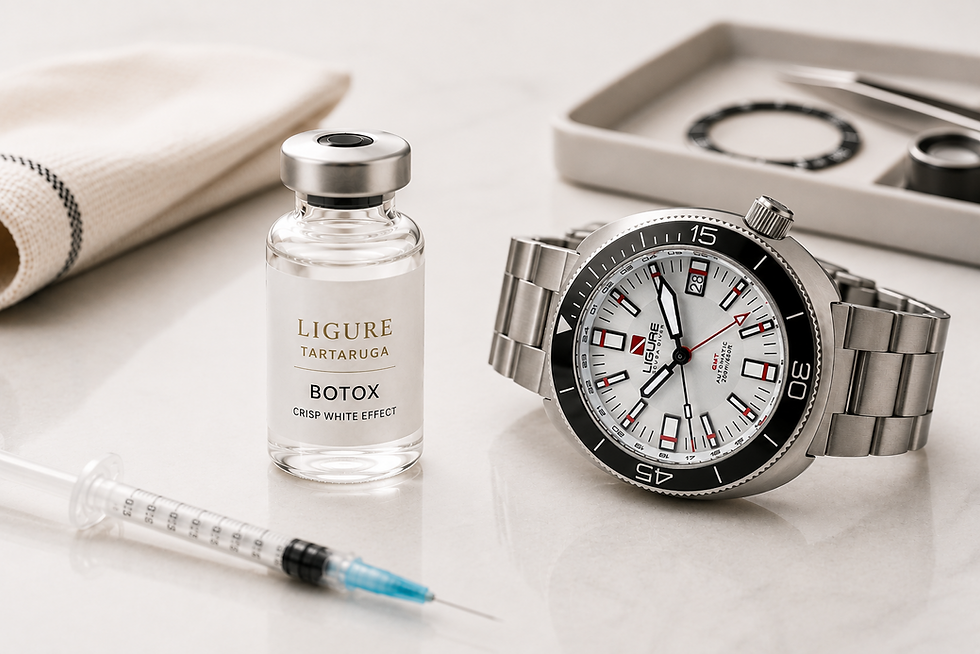
In our workshop, we sometimes joke that this is the closest thing watchmaking has to cosmetic surgery.
No scalpels.
No dramatic transformations.
Just white fresh, crisp luminous markers in your ceramic bezel insert and a smile when the owner sees their watch looking renewed.
Perhaps that's why we've occasionally referred to it as the "Ligure Tartaruga Botox Treatment."
Unlike the human version, however, this one never needs explaining at dinner.
Some Watches Measure Time.
A Ligure Collects It.


Comments